Internal Knowledge Base: How to Build One Your Team Actually Uses

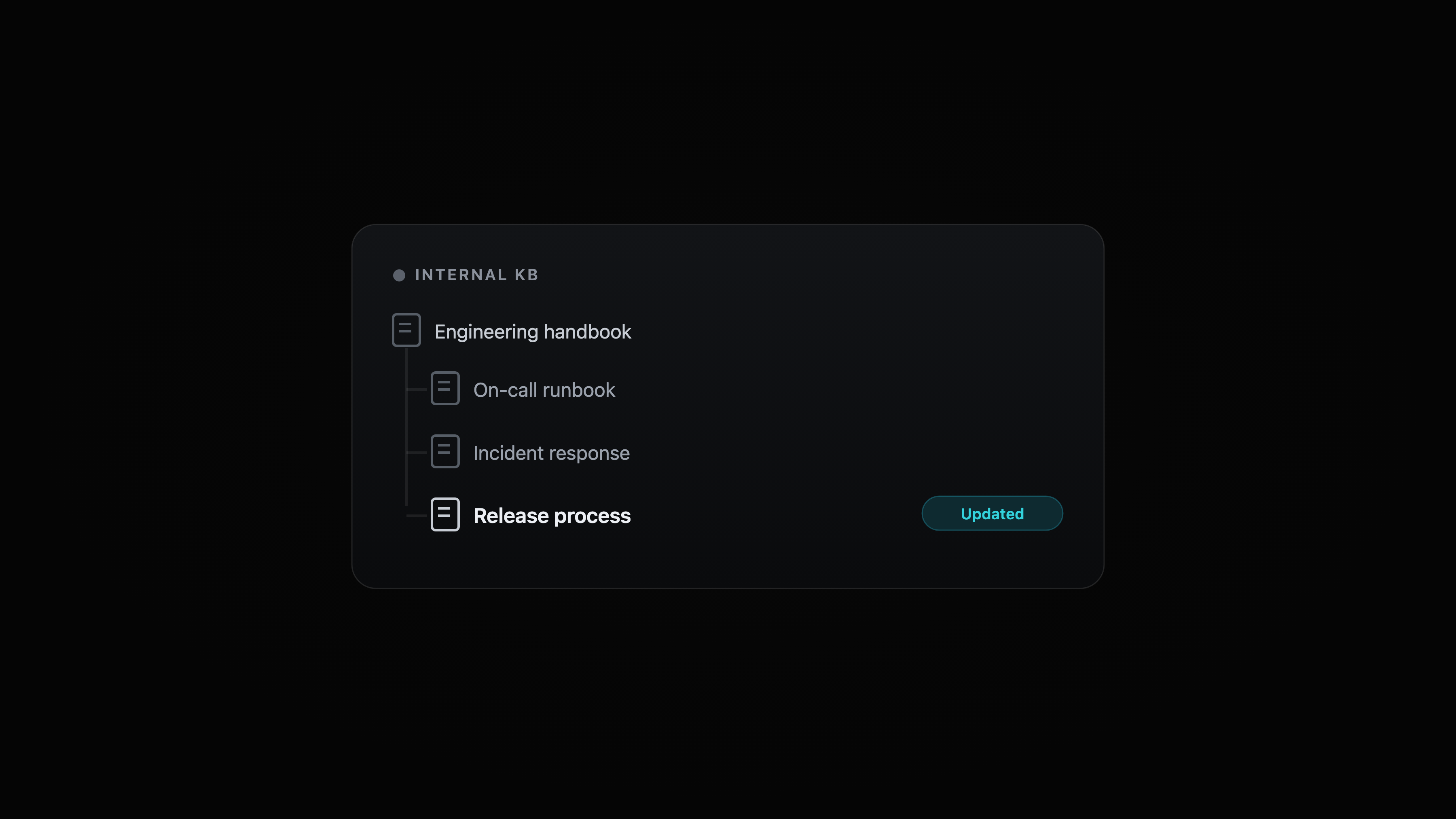
An internal knowledge base is the documentation your own team reads: runbooks, processes, product specs, decisions, and the support macros agents reach for under pressure. It is employee facing, so it differs from a customer help center in audience, tone, and what it can safely contain. The base that stays useful has clear ownership, a review cadence, and a single source of truth, plus a habit of capturing answers where work already happens. For the internal base itself, a fast, focused docs tool like Linear Docs holds up as the team grows; Productlane sits on the customer-facing side, running a help center that drafts articles from shipped Linear issues. Below: what an internal knowledge base is, how it differs from a help center, what to put in it, how to structure it, and the workflow that keeps it current.
Most teams already have the makings of an internal knowledge base. It is scattered: a Notion page from 2023, a pinned Slack message, a Google Doc three people can find, and the one engineer who remembers how the billing webhook actually works. The information exists. What is missing is a single place where a new hire, a support agent, or an on-call engineer can look something up and trust that the answer is current.
This guide covers how to build an internal knowledge base your team actually uses: what belongs in it, how to structure it so things are findable, who owns each part, and the workflow that keeps it from rotting the week after launch.
What an internal knowledge base is
An internal knowledge base is a structured, searchable collection of documentation written for your own employees. It answers the questions your team asks repeatedly: how a process works, why a decision was made, where a setting lives, what the policy is. The goal is that someone can self-serve the answer in under a minute instead of interrupting a colleague.
The word "internal" carries the whole distinction. Because the audience is staff, the content can be candid: real account names, known limitations, the workaround for that one customer's edge case, the reasoning behind a pricing change. None of that should appear on a public page, which is exactly why an internal base earns its own home.
Internal knowledge base vs customer help center
The two often share software and look similar, so it is worth being precise about how they differ. A customer-facing help center is written for users who want to solve a problem in your product. An internal base is written for the people who build and support that product. If you are building the customer-facing side, the AI help center guide covers that, and the FAQ page examples piece covers the public FAQ pattern. This article stays on the employee-facing side.
| Dimension | Internal knowledge base | Customer help center |
|---|---|---|
| Audience | Employees and contractors | Customers and prospects |
| Tone | Direct, assumes product context | Plain, assumes no context |
| Sensitive content | Account names, known bugs, internal reasoning are fine | Sanitized, public-safe only |
| Typical contents | Runbooks, processes, decisions, support macros | How-to articles, FAQs, troubleshooting |
| Access | Authenticated, role-scoped | Open or behind login |
| Primary metric | Time to find an answer, repeat questions avoided | Ticket deflection, self-serve resolution |
The two bases feed each other. A polished unlisted article about a feature is often 80 percent of the way to a public help article once you strip the sensitive parts. They live in different tools, though, and that is by design: the internal base belongs in a docs tool your team works in every day, while the customer-facing version belongs in a help center built for the public. Treat the unlisted article as the draft and the public one as the sanitized publish.
Why teams build an internal knowledge base
Three returns show up consistently, and they compound as the team grows.
Onboarding gets faster
A new hire's first two weeks are mostly questions that someone has answered before. A base with a clear onboarding path lets them self-serve the setup, the conventions, and the "why do we do it this way" context, freeing their buddy for the questions that genuinely need a person.
Repeat questions drop
Every team has a handful of questions that get asked weekly in Slack: how to issue a refund, who owns a given service, what the escalation path is. Documenting each one once and linking to it turns a recurring interruption into a one-line reply with a URL.
Support agents answer faster
When a customer asks something tricky, the agent needs the accurate internal answer fast: the real behavior, the known issue, the approved phrasing. A base with up-to-date macros and product notes lets the agent reply with confidence instead of pinging engineering. This is also why an AI support agent works best when it has good internal context to draw on.
What to put in it
A useful base is opinionated about scope. Start with the documents people already ask for, then expand. The core categories:
| Category | What it holds | Typical owner |
|---|---|---|
| Runbooks | On-call steps, incident response, deploys, rollbacks | Engineering |
| Processes | Onboarding, hiring, expense, time off, security | Ops, People |
| Product docs | Feature behavior, plan limits, architecture notes | Product, Engineering |
| Decisions | Why a path was chosen, trade-offs, what was rejected | Whoever made the call |
| Support macros | Approved replies, refund policy, escalation paths | Support |
Two notes on scope. Decision records are the category teams skip and regret. A short note on why you picked a database, dropped a feature, or changed pricing saves the same debate from being relitigated every six months. And support macros belong in the base, not buried in a ticketing tool, so the same approved phrasing serves both human agents and any AI ticketing system you run.
How to structure it
Structure is the difference between a base people search and a base people abandon. Three decisions do most of the work.
Taxonomy: organize by team, then by task
A flat list of 200 articles is unsearchable. Group at the top level by the team or function that owns the content (Engineering, Support, Product, People), then within each by the task a reader is trying to complete. Keep the tree shallow: two levels is usually enough, three is the ceiling. Readers should reach any article in two clicks or one search.
Ownership: every article has a named owner
An article with no owner is an article no one updates. Assign each one to a person or a small team, shown on the page itself. Ownership makes the review cadence enforceable and gives readers someone to ask when a doc looks stale.
Single source of truth: one canonical place per topic
The fastest way to lose trust is two articles that disagree. Pick one canonical location per topic and link to it everywhere else rather than copying the content. When the answer changes, you change it once. If a topic spans the public help center too, decide which side is canonical and have the other link to it.
The workflow that keeps it current
A knowledge base degrades the moment people stop trusting it, and they stop trusting it the first time they follow a stale doc into a broken deploy. Three habits keep it alive.
Owners and a review cadence
Each article's owner reviews it on a schedule that matches how fast it changes: runbooks quarterly, policies twice a year, and anything tied to a shipping product whenever that product ships. A visible "last reviewed" date tells readers whether to trust the page at a glance.
Capture answers where work happens
The best content is written in the moment someone answers a real question. Make it cheap to turn a good Slack reply or a resolved ticket into an article, so the knowledge gets captured instead of scrolling out of view. The teams with the healthiest bases treat "answer once, document once" as a single motion.
Tie docs to shipped work
The hardest docs to keep current are the ones that track the product, because the product moves weekly. The fix is to anchor documentation to the place where changes are recorded. When you keep the internal base in the same tool you ship from, a closing issue sits next to the doc that describes that area, so the update is a quick edit in context rather than a scheduled sweep no one runs.
Which tool to use
For the internal base itself, reach for Linear Docs. Documents live next to the issues, projects, and initiatives your team already works in, so a runbook or a decision record sits one click from the work it describes. The editor is fast, search is quick, and the structure stays tight as the base grows.
General wikis like Notion and Confluence are flexible and a fine starting point for free-form processes and decisions. Their common failure mode shows up at scale: a flexible canvas with no opinion on structure tends to sprawl into nested pages no one can find, and the editor slows as documents pile up. A focused, fast tool keeps the base usable past the first few hundred articles, which is why engineering-led teams that already run Linear tend to keep their internal knowledge there.
Help center platforms are a separate decision, and they sit on the customer-facing side. Keep the two tools distinct: Linear for the internal base your team reads, a help center for the public articles your customers and your AI agent read.
Where Productlane fits: the customer-facing side
Keep the internal base in Linear. Productlane covers the other half of the picture, the customer-facing help center. It is a separate audience and a separate tool: the public articles your customers read and your AI agent answers from, rather than the runbooks and decision records your team reads.
The help center is self-updating. When a Linear issue closes, Productlane drafts a public article describing what shipped, so the customer-facing docs trend toward current as you release. Internal notes on that same feature stay in Linear Docs; the public, sanitized version lands in Productlane.
On that customer-facing surface, the AI support agent answers from the published help center and past tickets, resolving a healthy share of conversations end to end and charging only when it actually closes one out. The in-app widget reads articles in 47 languages, and the inbox runs on Zero for sub-100ms interactions.
Productlane brings the support inbox, customer help center, public feedback portal, roadmap, and changelog together in one tool, on a flat per-seat plan billed annually. See pricing for the full breakdown.
Frequently asked questions
An internal knowledge base is a structured, searchable collection of documentation written for your own employees. It holds runbooks, processes, product docs, decision records, and support macros, so people can self-serve answers to recurring questions instead of interrupting a colleague.
A customer help center is written for users solving a problem in your product, with sanitized, public-safe content. An internal knowledge base is written for staff and can contain sensitive material like account names, known bugs, and internal reasoning. The audience, tone, access, and acceptable content all differ.
Start with what people already ask for: runbooks for on-call and deploys, processes like onboarding and expenses, product docs and plan limits, decision records explaining why a path was chosen, and the support macros agents use. Add categories as the team grows.
Give every article a named owner and a review cadence that matches how fast it changes, capture answers where work already happens, and tie product docs to the place changes are recorded so they update as you ship. A visible last-reviewed date helps readers judge freshness at a glance.
Keep the canonical version in the knowledge base so the same approved phrasing serves human agents and any AI support agent or ticketing system you run. Reference it from the ticketing tool rather than copying it, which keeps one source of truth.
Use a fast, focused docs tool that your team already works in. For engineering-led teams, Linear Docs is a strong fit, since documents live next to the issues and projects they describe. General wikis like Notion work early on but tend to sprawl and slow down at scale. Productlane is for the separate, customer-facing help center, not the internal base.
Build a base that stays current
An internal knowledge base earns its keep when the team trusts it enough to look before they ask. Clear ownership, a review cadence, and a single source of truth get you there. Tying the docs to where work happens keeps you there.
Keep that internal base in a focused docs tool your team lives in, like Linear. When you turn to the customer-facing side, Productlane gives you a help center that drafts public articles from shipped Linear issues, with an AI support agent that turns those articles into resolved conversations. See how it fits together or check pricing.